
What a Stamped Concrete Patio or Walkway Costs in the GTA
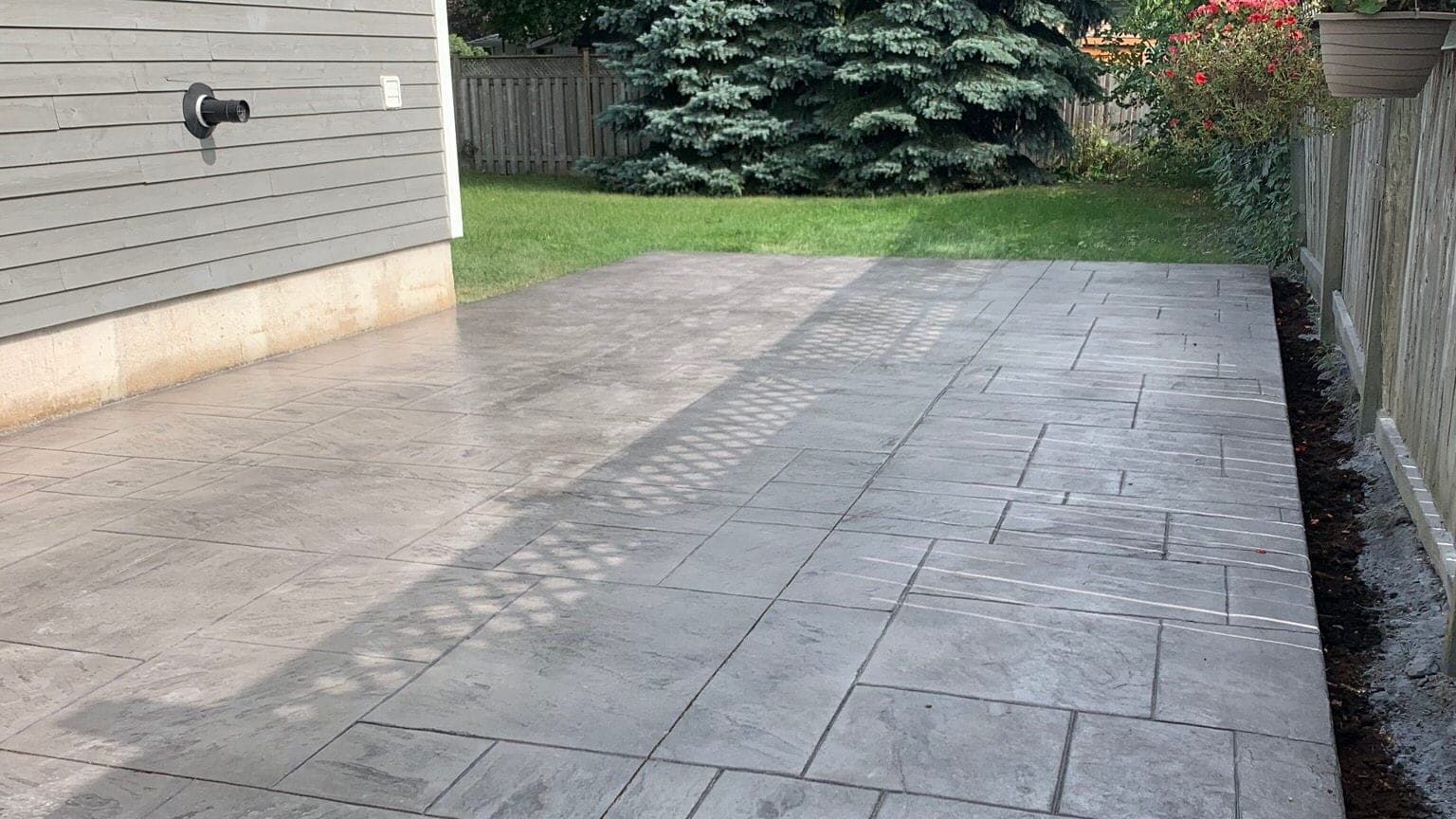
Stamped concrete is the finish most homeowners ask for by name, and it is also the one where quotes swing the most. Two contractors can land ten dollars a square foot apart on the same patio and both be quoting honestly, because stamped concrete is really three jobs stacked together: a structural slab, a pattern and colour application, and a sealing system that has to survive Ontario winters. Here is what stamped concrete, along with its broom and exposed aggregate cousins, costs across Toronto, Mississauga, Oakville, Burlington, and Milton in 2026, and what keeps one installation looking good for fifteen years while another flakes by its third spring.
2026 Price Ranges by Finish
Installed concrete generally runs $9 to $15 per square foot for a plain broom finish, $12 to $20 for exposed aggregate, and $14 to $25 for stamped. Those are the same ranges we quote on the concrete patios and walkways we build across the GTA.
| Finish | Typical 2026 installed cost | What the price covers |
|---|---|---|
| Broom finish | $9 to $15 per sq ft | One pour, a broom pass for grip, one colour at most |
| Exposed aggregate | $12 to $20 per sq ft | An extra step washing back the surface to reveal the stone in the mix |
| Stamped | $14 to $25 per sq ft | Release agent, pattern mats pressed into the wet slab, usually a second colour, and sealing |
Stamped sits at the top because it is the most hands-on finish there is. The mats have to go down in a narrow window while the concrete is still workable, edges and corners are textured by hand, and most jobs add an antiquing colour afterward that settles into the pattern lines. More steps and more skilled labour mean more price. Removing an old patio or walkway, and correcting the grade so water runs away from the house, are priced on top of these ranges.
Design Choices That Change Price
Within the $14 to $25 stamped range, the biggest swings come from pattern and colour rather than square footage. A single stamp pattern in one base colour sits at the lower end. Two-tone colour work, a base colour plus an antiquing release colour that settles into the texture lines, adds a full extra labour pass. Multiple patterns, contrasting borders, and curved layouts that need more hand-formed edges push the number up for the same reason a complex paver pattern does: more cutting, more fitting, more time.
Patio vs Walkway Cost Drivers
A stamped patio and a stamped walkway of the same square footage rarely land at the same price per foot. A walkway is long and narrow, with far more edge and more control joints for the area it covers, and every edge is formed and finished by hand. A patio is usually one open field with a simple perimeter, so the same crew covers more ground per hour.
Size works against small jobs too. A short walkway or a small patio needs the same crew, setup, and minimum concrete order as a larger one, so those fixed costs spread across less area and the per-foot price climbs. Access does the rest: on a Toronto semi with a narrow side yard and no rear lane, concrete gets wheeled in by the barrow load, while an open Milton or Burlington lot lets the truck reach the forms directly.
Is Stamped Concrete Cheaper Than Pavers?
Generally yes, on day one. On a common 300 square foot rear patio, stamped concrete at $14 to $25 a foot works out to roughly $4,200 to $7,500, while the same patio in pavers typically runs $6,000 to $10,500, as our paver patio cost guide breaks down.
The trade-off shows up later. Stamped concrete cannot be repaired invisibly. A cracked or spalled section can't be patched to match, because reproducing the original colour and the depth and wear of the stamped texture is somewhere between very difficult and impossible, so damage usually means living with it or replacing that section of slab. Interlock doesn't have that problem, since a settled or stained paver is lifted and relaid. Our stamped concrete vs interlock comparison covers that trade-off in full.
Sealing and Resealing
Sealing is not a cosmetic extra. It is part of the system. The sealer keeps water, salt, and UV light from working into the surface and attacking the colour and texture underneath, and an unsealed stamped patio fades, chalks, and stains faster than almost any other outdoor surface in a GTA backyard.
How often it needs resealing depends on exposure more than age, but for most GTA patios it works out to every two to three years. A shaded walkway with mostly foot traffic can go longer. A south-facing pool patio in full sun, or a front walk that gets salt tracked across it all winter, needs it sooner, because sun breaks the sealer down from above while salt works on it from below. Check it each spring: when water stops beading on the surface and starts soaking in, it is time.
Salt, Freeze-Thaw and Air Entrainment
Does salt damage stamped concrete? It can, and the damage shows more than on a plain finish. Deicing salt lowers the freezing point of water sitting on and in the concrete, so the surface goes through more freeze-thaw cycles each winter, and each cycle stresses the top few millimetres of the slab, right where the stamped texture and colour live. On an unsealed or poorly sealed surface, that shows up as scaling, flaking, or a chalky film, and because stamped concrete's value sits in that surface layer, damage there is far more visible than on a broom finish.
A few habits go a long way. Keep deicers off a new slab for its first winter and use sand for grip instead. After that, shovel before you salt, use plain salt sparingly, and avoid any product containing ammonium nitrate or ammonium sulfate, which attack concrete chemically rather than just through freezing.
This is also why the mix and base matter as much as the finish. A slab built correctly starts with a compacted granular base and a thickness matched to its load, backed by mesh or rebar and control joints cut at the right spacing so any cracking happens where it was planned. The mix should be air-entrained, meaning it is made with microscopic air bubbles that give freezing water room to expand without breaking the concrete around it. Add proper curing time and the patio is built to take an Ontario winter rather than hope to survive it.
Stamped concrete remains one of the best-looking surfaces you can put down for the money, and the sealing and salt realities above are manageable with a little seasonal attention, not a reason to avoid it. What decides whether yours still looks right in ten years is the same thing on every concrete job: the base, the mix, and the install, not the pattern on the sample board. Our concrete team builds stamped, exposed aggregate, and broom finish patios and walkways across Toronto, Mississauga, Oakville, Burlington, and Milton. Request a quote and we will walk your property, check access and drainage, and price the job your space actually needs.
Related Articles
More where this came from
Project ideas, seasonal maintenance tips and what we are building around the GTA. One email a month, and you can leave any time.