
What Yard Grading and Drainage Fixes Cost in the GTA
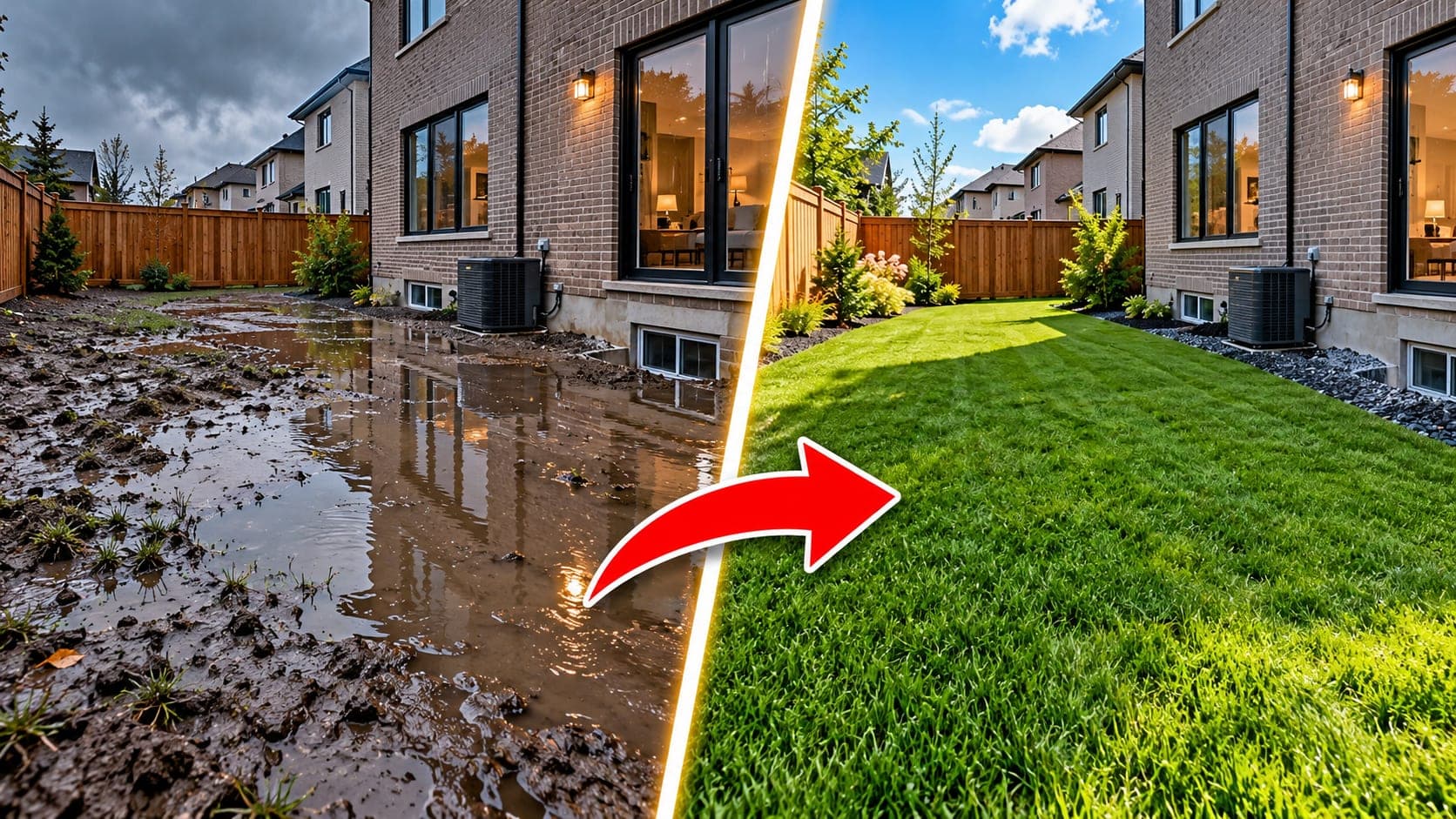
A yard that drains toward the house instead of away from it is one of the most common calls we get across the GTA, and it rarely shows itself until the basement window well is full or the lawn won't dry out between rains. Grading is unglamorous work, and almost nobody budgets to fix it until something downstream has gone wrong. Here is what regrading and drainage fixes cost in Toronto, Mississauga, Oakville, Burlington, and Milton, and when sod alone finishes the job.
Signs Your Yard Needs Regrading
The clearest sign is water sitting somewhere it shouldn't: against the foundation, against a fence, or in a low spot that stays soft for days after everything else has dried. A window well that fills during heavy rain is the same problem from a different angle, and so is mulch washing out of beds along the house whenever it rains hard.
Winter adds a second clue. Ice sheeting on a walkway in spots that never used to freeze over usually means water is draining there and sitting before it can run off. A damp basement smell every spring thaw, with no visible leak, is often a grading issue rather than a foundation one, worth ruling out before anyone talks about waterproofing.
What Drives Grading Cost
Access is the first variable, same as on any excavation job here. A rear yard reachable through a wide gate moves soil efficiently, while a narrow side passage means wheelbarrows and a higher price for the same volume of dirt.
The second variable is how far off the grade actually is. A few inches of correction near the foundation is a different job from a real low point that needs building up with imported fill, and the more material that has to come in rather than be reshaped, the more it costs. What is already there matters too: stripping an existing lawn, or removing an old patio or debris first, adds to the earthwork, and new drainage prices as its own scope.
Typical GTA Price Ranges
Because grading is rarely sold alone, the clearest window into the real number is the sod work that usually follows it. Sod laid on ground already properly graded runs roughly $1.50 to $3.00 per square foot installed. Where the job includes correcting the grade, bringing in topsoil, and removing an old lawn, that climbs to roughly $2.50 to $5.00 per square foot, and the gap is essentially what the grading itself costs.
Where you land inside that range depends on how much correction the site needs and how equipment reaches the yard. An open Milton or Burlington lot sits toward the lower end; a tight Toronto or Mississauga lot with a narrow side gate and a real low spot to fill sits toward the top.
Swales, Downspouts, and When Grading Isn't Enough
Many drainage problems are solved by grading alone, reshaping the dirt so water runs where it should instead of where it collects. Downspout extensions that carry roof water a few feet past the foundation, instead of dumping it against it, often do more good than their cost suggests and belong in almost every regrade.
Some lots need more. A shallow, wide swale, a gentle channel across the yard, is the standard answer once water has to travel from a low point to an outlet, because a swale moves volume a flat regrade cannot. On a lot with a genuine elevation change, cutting into the grade to fix the slope can undermine what is holding soil up on one side, which is exactly when a slope needs a retaining wall instead of a regrade, since holding soil back mechanically is a different project with different engineering behind it.
Municipal Lot-Grading Rules and New-Build Certificates
On a new build or major addition anywhere in the GTA, municipalities generally require a lot grading certificate before sign-off, confirming the finished grade matches the approved plan and that water goes to the street or another approved outlet, not onto the neighbouring lot. That certificate is usually prepared by an engineer or surveyor and tied to the building permit.
Regrading an existing yard on its own is different: it typically does not need a separate permit, but you still cannot solve your own drainage problem by sending water onto the lot next door, and a municipality can require a fix if a neighbour complains. The standard contractors build to, on new builds and simple regrades alike, is roughly a two percent slope away from the foundation, about a quarter inch of fall per foot, held for the first six feet out from the house. Confirm specifics with your own municipality before finalizing a design, since requirements vary across Toronto, Mississauga, Oakville, Burlington, and Milton.
Sod or Seed After Grading
Sod will not fix a low spot. It is a finished surface, not a correction, and laid over ground that still slopes the wrong way it greens up for a few weeks and then starts holding water again, same as before. The grading has to be right first. Once it is, sod beats seed on a regraded yard, since it gives you a usable lawn in weeks instead of a season and holds the new grade in place right away rather than leaving bare soil to wash out in the first hard rain.
Timing matters for the sod, though not for the grading. Grading can be done in fall without issue, right up until the ground freezes, and it's often a good time for it since the yard isn't in active use. What changes by season is when you lay sod: the two strongest windows are spring, roughly May into June, and early fall, September into mid-October, when soil is warm and moisture is reliable. Mid-summer is the hardest stretch to establish new sod, since July and August heat dries it out faster than most people can keep up with. If grading finishes right before freeze-up, grade now and hold the sod until spring rather than rush it into a window where it won't root.
Water doesn't wait for a convenient season, and a yard already sending it toward the house won't improve on its own. Our grading and sodding services cover everything from correcting the slope to the finished lawn on top of it, across Toronto, Mississauga, Oakville, Burlington, and Milton. Request a quote and we'll walk the property with you, read where the water is actually going, and tell you honestly whether the fix is a regrade, a swale, or something bigger.
More where this came from
Project ideas, seasonal maintenance tips and what we are building around the GTA. One email a month, and you can leave any time.