
Interlock, Natural Stone or Concrete Around Your Pool?
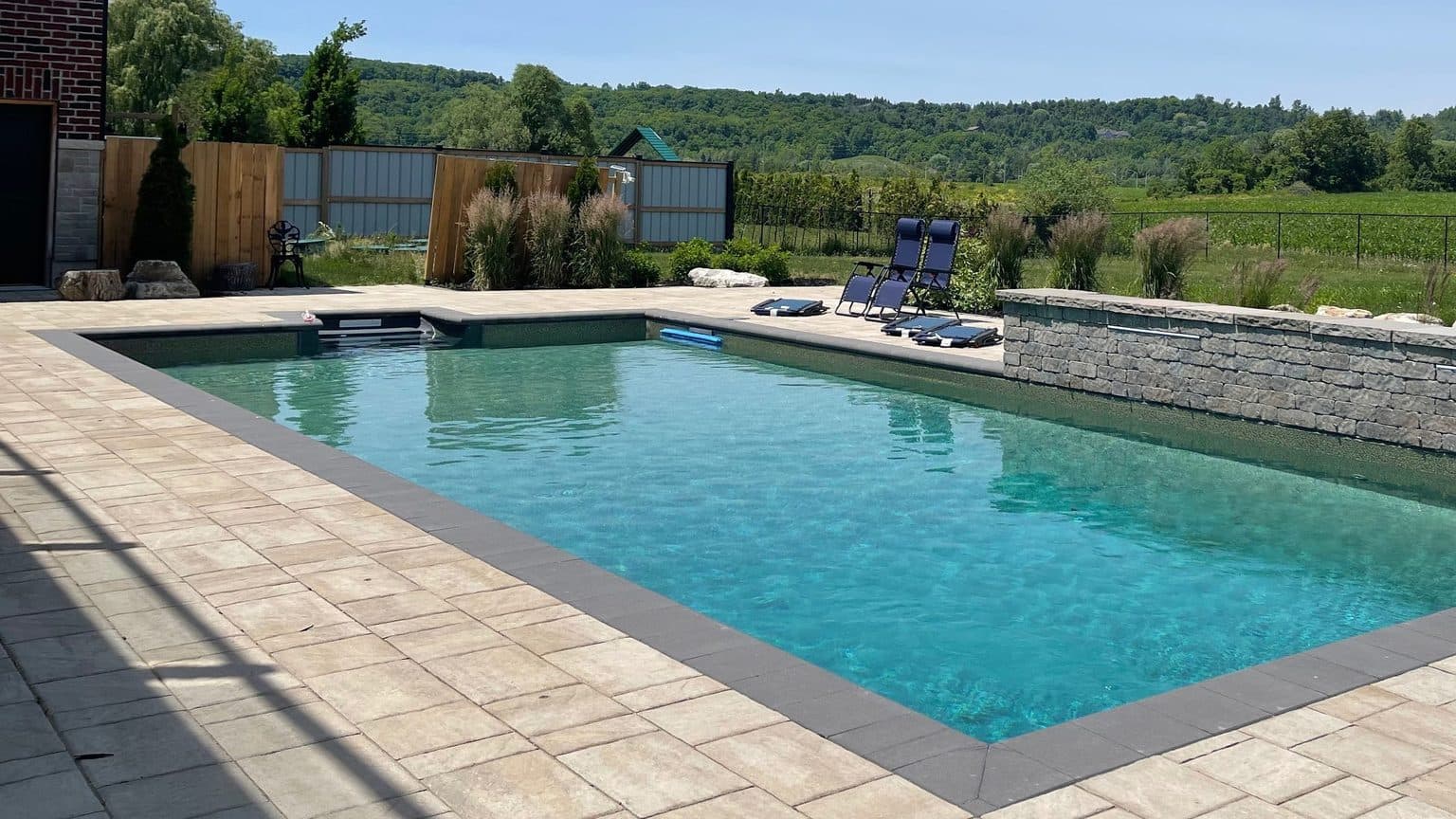
Most pool deck advice online comes from someone who sells one material: a paver manufacturer pushing interlock, or a concrete crew pushing a slab. We install interlock, natural stone, and concrete around pools across Toronto, Mississauga, Oakville, Burlington, and Milton, often on the same project, so here is what actually separates them: heat underfoot, grip when wet, how the coping ties into the shell, and how each one holds up through an Ontario freeze-thaw cycle.
Pool Deck Materials Compared
| Material | Typical 2026 installed cost | Where it shines | What to watch |
|---|---|---|---|
| Interlock | $18 to $35 per sq ft | Repairs invisibly, and pavers lift out to reach buried pool lines | Joint sand needs its full cure time before the pool is filled |
| Natural stone | Above interlock for the same area, with coping priced per piece | Bullnose coping, the most comfortable edge to sit on | Pick a textured face, since honed or polished stone is slick when wet |
| Concrete | $9 to $25 per sq ft, depending on finish | Lowest cost and one continuous surface | Needs a grippy finish, and a cracked section cannot be patched to match |
The interlock and concrete ranges are the same ones we quote on driveways and patios. Natural stone varies too much with the stone itself, its thickness, and how it is cut to give a fair per-foot number without seeing the job.
Why the Surround Adds 20 to 40 Percent to a Pool Budget
The pool shell is the number people focus on, but it is rarely the whole invoice. Coping, decking, patio, and the landscaping that turns an excavated hole into a finished backyard commonly add 20 to 40 percent on top of the pool itself, as our inground pool cost guide shows. That holds whether the shell is fibreglass or concrete, because the surround prices on its own terms: square footage, base depth, material, and access.
Homeowners often budget the shell first and treat the surround as whatever is left, which is backwards. The deck is the part everyone actually touches, barefoot, every swim, for decades after the pump and heater have been replaced. Price it alongside the pool from the first quote.
Interlock
Interlock runs $18 to $35 per square foot installed, the widest range of the three because it covers the widest range of product. A standard paver in a running bond sits near the bottom. Large format slabs, a contrasting soldier course along the coping, or a custom field pattern push it toward the top.
What interlock does better than stone or concrete is repair. A paver that heaves after a hard freeze, or picks up a rust stain from pool equipment, gets lifted and relaid, and the patch disappears. That matters more around a pool than on a driveway, because the skimmer and return lines run under the deck, and one day someone may need to get at them. The trade-off is the joints. Polymeric sand takes constant splash differently than rain, and sand that does not get its full cure time before the pool is filled washes out sooner than it would on a dry patio. Our interlock crews schedule the jointing around the fill date for that reason.
Natural Stone and Coping
Natural stone sits above interlock for the same square footage, and coping is usually priced per piece rather than by the square foot, since the labour is in fitting each piece to the pool's edge rather than covering open ground. That is where stone earns its price. The pool edge is the one surface on the property people grip, sit on, and climb out over, barefoot, every swim.
The edge profile matters more than the type of stone. Bullnose, machined to a rounded edge, is the standard choice for coping because it is comfortable to sit on and has no sharp lip to catch a toe. Rockface, the chiselled, rough-quarried look, suits a porch or entry steps, not a coping stone people sit on in swimsuits for twenty years. The flat face matters too: a flamed or sawn finish gives a wet foot grip, while honed or polished stone belongs on a kitchen counter. Our natural stone crews price coping as its own line, separate from the rest of the patio.
Concrete
Concrete runs $9 to $25 per square foot depending on finish: broom at the low end, exposed aggregate in the middle, and stamped at the top once forming and colouring are added, as our stamped concrete patio cost guide breaks down. It is the cheapest way to get a continuous, joint-free surface around a pool.
Finish matters more than colour here. A smooth trowelled finish gets slippery when wet, so broom or exposed aggregate is the right call around water. Stamped concrete works too, as long as the sealer has an anti-slip additive mixed in, because a glossy sealer on a pool deck is asking for a fall. Control joints should follow the shape of the pool rather than a generic grid, so any cracking happens where it was planned instead of running toward the coping. Some hairline cracking over time is normal for any slab in this climate, and a contractor who promises otherwise around a pool is not being straight with you. What concrete cannot do is hide a repair, so the base and the joints have to be right the first time. Our concrete team pours pool decks on a compacted base with an air-entrained mix for exactly that reason.
Which Pool Deck Material Stays Coolest?
It is the question we hear most, and colour decides it more than the material does. A light broom-finished concrete or a light interlock paver stays noticeably cooler underfoot on a July afternoon than a dark paver or a dark, dense stone. If the design calls for a darker accent, such as a charcoal coping band, keep it to a narrow border and let the main deck stay light.
Grip follows texture. Broom or exposed aggregate concrete, textured interlock, and a flamed or sawn stone face all give a wet foot something to hold. Anything smooth enough to look polished is too smooth for a pool deck.
Coping on a Fibreglass Pool
Fibreglass shells raise a specific coping question. The shell has a flat lip around its top edge, and a concrete bond beam is poured around it to lock it in place. The coping sits on that beam and overhangs the water slightly, and the deck behind it slopes away from the pool, so splash and rain run off into the yard instead of back down behind the shell. Get that detail wrong and water works its way behind the shell every time it rains, which over time can wash out the backfill holding the shell in place. That is a structural problem, not a cosmetic one.
Fencing and Enclosure Tie-ins
Every GTA municipality requires a compliant pool enclosure, with fence height, self-closing and self-latching gate hardware, and climbable-object rules set by each city's bylaw, and it has to be in place before the pool is filled. That part is not optional and not something to phase.
Does the rest of the surround have to be built in year one? No. What does have to happen early is the fence footings. Posts set in concrete, or piers wrapped in interlock or stone, need to go in before the final hardscape is laid, because cutting pavers around a post nobody planned for looks worse than a layout designed around it. A sensible sequence is the pool, the safety fence, and a working apron of coping and decking in the first season, with the rest of the patio and any stone cladding on the posts the following year once the budget resets.
Which material is right for your yard usually comes down to budget first, then how each part of the deck gets used: barefoot traffic at the coping, a dining area set back from the water, a patio that should match an existing driveway. Plenty of the best pool decks mix them, such as stone coping around an interlock field. We build pools and the interlock, natural stone, and concrete around them as one connected project across Toronto, Mississauga, Oakville, Burlington, and Milton, so we can tell you which material fits your lot rather than which one we happen to sell. Request a quote with the shape of your yard and we will price the options side by side before you commit to any of them.
Related Articles
More where this came from
Project ideas, seasonal maintenance tips and what we are building around the GTA. One email a month, and you can leave any time.