
What a Swim Spa Really Costs Installed in Ontario
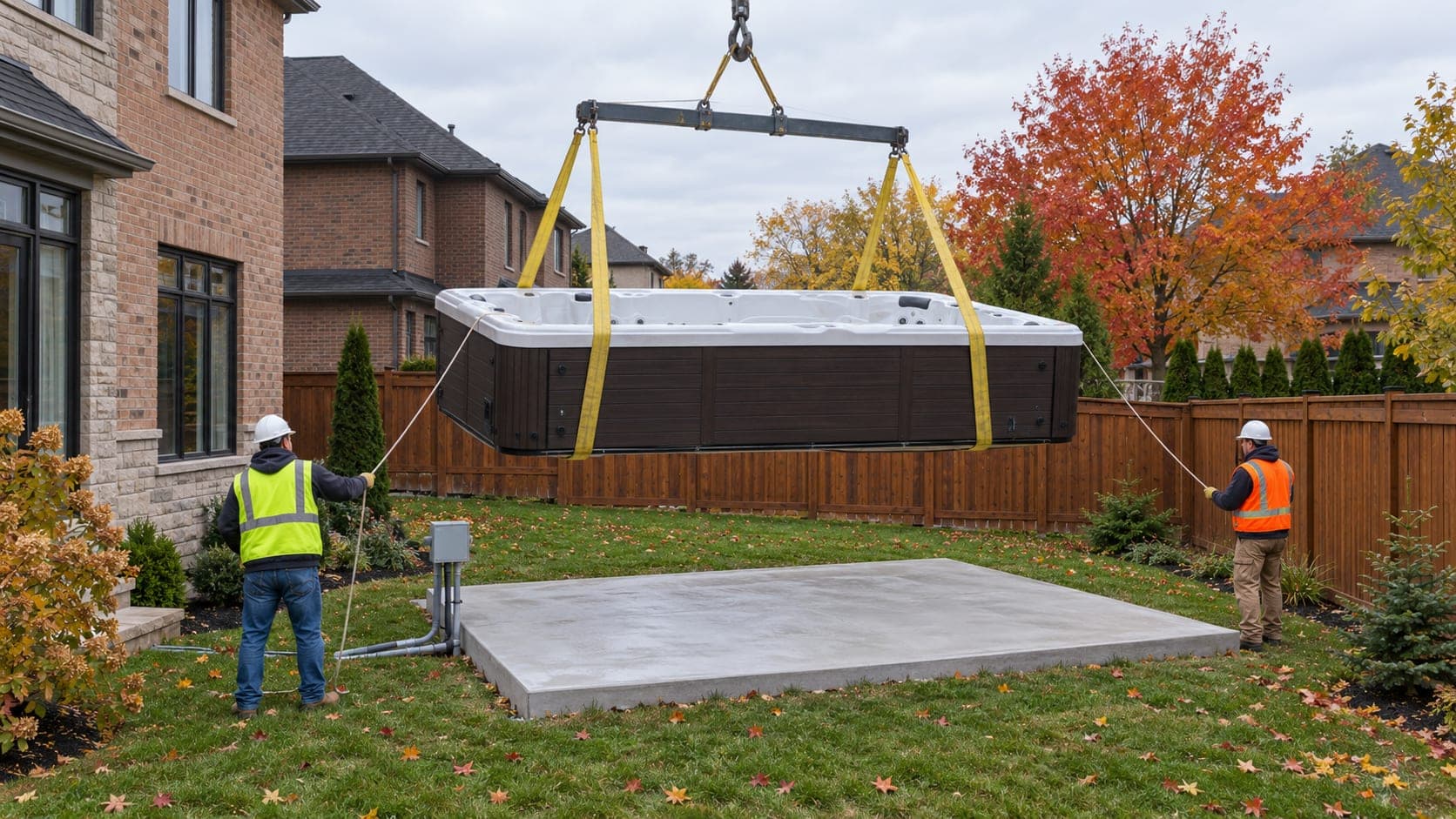
Price a swim spa online and the number you land on has little to do with what ends up on the final invoice. The unit, the part with a model number and a spec sheet, is one line item. Getting it running in a Mississauga or Oakville backyard also means a concrete pad built for its filled weight, a dedicated electrical circuit under permit, and in plenty of GTA yards, a crane to get it over a fence or past a narrow side gate. Here is how the real installed number breaks down, by install type and by what your site needs first.
Swim Spa Cost: Unit Price vs Installed Price
Dealer sites price the unit, which makes sense, since the unit is what they sell. That sticker price is the same whether the spa lands on an open Milton lot or a tight Toronto semi, and everything that changes from yard to yard sits outside it. Complete installed swim spa projects in Ontario generally run $35,000 to $70,000, covering the unit, an engineered concrete pad, electrical, and delivery. On a typical property, the site work alone commonly adds $10,000 or more on top of the unit.
Cost by Install Type: At Grade, Partially Recessed, Fully Recessed
The three install types sit on a sliding scale of site work, and the price moves with them. The same unit can land at very different points in the installed range depending on which one your yard calls for.
| Install type | What it involves beyond the unit | Where it tends to land |
|---|---|---|
| At grade | A level, engineered pad with skirting around the base. Excavation stops at the pad footprint. | Lower end of the range |
| Partially recessed | The unit drops part way into the ground, adding excavation, a retaining structure on at least one side, and drainage so water does not collect against the shell. | Middle of the range |
| Fully recessed | The spa sits flush with the surrounding patio or deck, which takes the most excavation, a structural wall or vault, and drainage sized for a buried structure. | Upper end of the range, before any surround |
At grade is the most common choice and the most forgiving. Recessed installs are chosen for looks and access: a spa you step down into from a deck reads as a built-in feature rather than an appliance sitting on a slab, and it is easier to get in and out of. That finish is what the extra excavation and structure pay for.
The Pad: What It Has to Carry
The pad is not a generic slab. It is reinforced concrete engineered to the filled weight and footprint on that model's spec sheet, and sized to the site's soil and frost conditions. How thick should a swim spa pad be? There is no single number that fits every unit, since a large spa with seating at one end can weigh thousands of pounds more when filled than a compact lap model, and the pad has to be built for that real number rather than a rule of thumb.
Setting a spa on existing pavers or a patio slab built for foot traffic is the most common and most expensive mistake on these installs. Pavers shift under the load, a thin slab cracks, and the fix means draining the unit, moving it, and pouring the pad it needed in the first place.
Electrical and Crane Access
Electrical is its own trade and its own line on the quote: a dedicated 240 volt circuit at high amperage, run by a licensed electrician under an Electrical Safety Authority (ESA) permit. The cost depends mostly on distance and capacity. A panel on the back wall close to the pad is a short run; a panel at the front of the house, or one that needs upgrading to carry the load, is a longer and more expensive job.
Access is the part most people do not price until delivery day. A measured route from the street to the pad decides whether the unit rolls in on a dolly or needs a crane lift over the fence or the house, and swim spas are big enough that many GTA side yards are simply too narrow. On tighter Toronto lots, the crane belongs in the original quote, not as a surprise the week of delivery.
Decks, Pergolas, and Enclosures
A swim spa needs nothing beyond its pad and electrical to work, but few owners stop there. A surrounding deck, privacy screen, or pergola turns a unit on a slab into part of the yard instead of equipment sitting in it, and recessed installs in particular look unfinished without a surround built around the access points. Solariums and glass rooms go further, enclosing the spa so it stays comfortable to use through the coldest months, at a cost that sits on top of the spa project rather than inside it.
Because we build both the swim spa installation and the structures around it, the two get designed together. That matters more than it sounds: a pad poured without the deck in mind can leave the spa at the wrong height for the surround, or box in the equipment access panel a technician will need to reach later.
Permits and Fencing
Do you need a permit for a swim spa? For the electrical, yes, every time: the 240 volt circuit is ESA-permitted work. Beyond that, it depends on your municipality and on what gets built around the unit. A deck, pergola, or enclosure can need its own building permit, and our drawings and permits service handles that application as part of the project.
Fencing is where the rules vary most. Each municipality's own by-law decides whether a swim spa is treated like a hot tub or like a pool, and whether a locking safety cover is enough or pool-style enclosure fencing is required. That differs between Toronto, Mississauga, Oakville, Burlington, and Milton, so confirm with your building department before the pad is designed, not after it is poured. Our swim spa vs pool comparison covers the wider differences between the two.
Running Costs Over a Winter
Can a swim spa run all winter? Yes, that is what the equipment is built for. An inground pool in Ontario is covered and shut down for most of the year, while a swim spa runs twelve months, and an insulated shell with a good cover is what makes a February swim in Burlington or Milton practical instead of miserable. Heating costs climb in the cold, as with any heated water outdoors, but a well-insulated unit keeps that increase roughly in line with running a large hot tub. The habit that matters most is keeping the cover on and locked whenever the spa is not in use, since holding a steady temperature costs less than reheating a spa that has been left to cool.
Buying the Unit Somewhere Else
One question comes up on nearly every consultation: can you install a unit I bought elsewhere? Yes. We install swim spas regardless of where they were bought, whether that is a dealer, a big-box store, or an online seller. What matters is having that exact model's spec sheet before the pad is poured, since filled weight, dimensions, and electrical draw vary by manufacturer, and a pad built for the wrong unit cannot be corrected afterward.
Getting a swim spa right in the GTA comes down to the same three decisions every time: the install type that suits your yard, a pad and electrical system built for the actual unit, and an access plan settled before delivery day. Our swim spa installation team handles all three, whether you already own a unit or are still deciding between a spa and a full pool. Request a quote and we will walk your property and price the install type that actually fits it.
More where this came from
Project ideas, seasonal maintenance tips and what we are building around the GTA. One email a month, and you can leave any time.